Best Dash Cam for Always-On Street Parking Protection
Street parking overnight is the harshest test for any dash cam's parking mode: low light, long duration, vehicle traffic passing all night, and a hit-and-run that may happen at 2 AM while you are asleep. This guide uses published power-draw, buffered-capture behavior, battery-cutoff requirements, an
Disclosure
Dash Ledger is reader-supported. If you buy through our links we may earn a commission — it never changes what you pay or how we rate a dash cam. All recommendations are based on published specifications and aggregated expert and owner reviews — not physical testing or overnight parking trials.
Street parking overnight in a dense neighborhood presents a different set of demands than a monitored parking garage or daytime lot. Vehicles pass continuously; lighting is variable; your car may sit unattended for eight to twelve hours. A hit-and-run happens in seconds, most often at low speed with minimal G-force — exactly the scenario that high-threshold motion-only parking modes miss. This guide establishes what reliable street-parking protection actually requires, then matches it to published dash cam specifications.
No spam. Unsubscribe anytime.
What Street Parking Protection Actually Requires
Based on published parking-mode documentation and aggregated expert analysis, reliable overnight street-parking protection requires:
- Buffered parking mode — not motion-only or time-lapse. A pre-event buffer (15–30 seconds) is the only way to capture the approaching vehicle before a low-speed hit.
- Hardwire kit with voltage-cutoff — mandatory for overnight duration. Protects the vehicle battery from discharge.
- Front and rear channels — a front-only camera in parking mode misses a vehicle that hits the rear bumper and drives away.
- Adequate storage — an 8-hour overnight park at continuous buffered bitrate fills cards faster than daytime drive-recording.
- Reliable G-sensor threshold calibration — a threshold set too high misses low-speed taps; a threshold too low triggers on passing trucks vibrating the street.
The Hardwire Kit: Why It Is Non-Negotiable
For any overnight parking-mode use, a hardwire kit is the required foundation. Without it:
- The cigarette-lighter socket loses power at ignition-off on most vehicles
- Parking mode is impossible without a continuous power source
- The camera provides zero protection while the car is unattended
A hardwire kit consists of: (1) a low-profile power cable with a micro-USB or USB-C connector, (2) a fuse-tap connector for the vehicle's fuse box, and (3) a voltage-cutoff relay that cuts power when the battery drops below a programmed threshold (typically 11.6V–12.2V). Install time for a DIY hardwire is approximately 30–60 minutes on most vehicles. → View hardwire kits for parking mode on eBay
Camera Picks for Overnight Street Parking
Pick 1: Nextbase Cameras With Parking Guard
Nextbase's parking-guard capable models — including the 622GW and the iQ — publish motion-detection parking mode with a configurable sensitivity threshold. The iQ additionally publishes Smart Sense cloud alerts for remote notification when motion is detected. For street-parked vehicles in high-risk neighborhoods, the iQ's LTE-connected push notification is a meaningful advantage: you can be alerted and review footage on your phone within minutes of a hit-and-run, potentially while the responsible driver is still nearby.
For standard overnight protection without a subscription cost, the Nextbase 622GW provides reliable local parking-mode recording via hardwire kit, with GPS overlay on all footage. → View Nextbase parking-mode cameras
Pick 2: Viofo A229 Pro (Buffered Parking Mode)
The Viofo A229 Pro publishes buffered parking mode with a 15–30 second pre-event buffer and front-and-rear two-channel recording. For street parking, the dual channel is particularly relevant: a vehicle that clips your rear bumper in a parallel-parking maneuver and drives away is documented by the rear channel, not the front. The A229 Pro's published Sony STARVIS 2 sensor also means the night footage quality in the parking-mode clip — recorded in low street lighting — is stronger than a standard CMOS sensor at the same resolution. → View Viofo A229 Pro
Required Setup: Step by Step
| Step | Action |
|---|---|
| 1 | Purchase camera with published buffered parking mode |
| 2 | Purchase compatible hardwire kit (check camera brand's published compatibility) |
| 3 | Install hardwire kit: locate always-on fuse slot, tap fuse, route cable |
| 4 | Set voltage cutoff on kit or in camera settings (typically 11.8V–12.0V for most vehicles) |
| 5 | Set G-sensor sensitivity: start at medium, adjust based on false triggers |
| 6 | Install high-endurance microSD card (256 GB minimum for overnight recording) |
| 7 | Verify parking mode is active: confirm the camera's indicator light or app status |
Power Draw and Battery Impact
Published power-draw figures for buffered parking mode across major brands:
| Mode | Typical Published Draw | Estimated Hours on 60 Ah Battery |
|---|---|---|
| Buffered (continuous) | 300–500 mA | ~50–80 hrs theoretical |
| Time-lapse | 150–250 mA | ~100–160 hrs theoretical |
| Motion-only (standby) | 100–200 mA | ~150–240 hrs theoretical |
These are theoretical estimates based on published current draw and battery capacity. Real-world results are lower due to battery age, temperature, and other draws. Always use a voltage-cutoff relay.
For overnight street parking (8–12 hours), buffered mode's ~400 mA draw on a healthy 60 Ah battery drops the battery by approximately 3–5 Ah — a small fraction of capacity. The risk is cumulative: if the battery is aging, if you park for multiple consecutive days without driving enough to recharge, or if the voltage cutoff is set too low, parking mode can contribute to a no-start condition. Set the cutoff at 11.8V or higher and test the battery health annually.
Storage Sizing for Overnight Parking
For an 8-hour overnight park in buffered mode (front + rear recording):
- Combined bitrate (front 4K + rear 1440p buffered): approximately 12–18 GB/hr
- 8 hours = approximately 96–144 GB
- 256 GB card minimum for an overnight session without overwriting the most recent clips before review
- 512 GB card preferred for continuous protection with comfortable margin
High-endurance microSD cards are required for parking-mode writing — standard cards wear out faster under continuous write cycles.
Honest Limitations
G-sensor threshold vs slow taps: A vehicle that slowly rolls into your bumper in a parking lot at under 3 mph may not exceed the G-sensor trigger threshold on any camera. Published sensitivity settings help but there is no published guarantee of triggering on the lightest glancing blows.
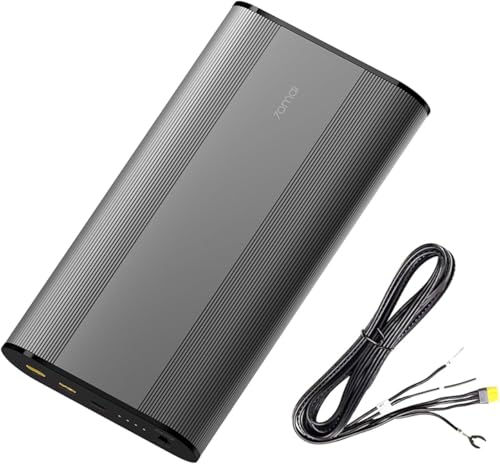
Battery packs as an alternative: For vehicles where fuse-box hardwiring is impractical (some lease terms prohibit modifications), a companion battery pack powers parking mode for 4–12 hours without any vehicle electrical work. Duration depends on the pack's capacity and the camera's power draw.
A dedicated pack like the 70mai BL96NNX is the plug-and-play version of this approach: a 96Wh LiFePO4 cell that hardwire-charges through the fuse box while you drive, then runs parking mode on its own power — up to 30 hours by its published rating — so the car's starter battery is never in the loop. It carries its own low-voltage protection, the same safeguard the hardwire section's cutoff relay provides, just built into the pack instead of the fuse tap.
Camera theft: A dash cam in parking mode that is stolen during a break-in is worthless as evidence. Some camera placements (suction-cup on glass) are visible and attractive to thieves. Adhesive mounts partially concealed behind the rearview mirror reduce visibility.
Bottom Line
The effective overnight street-parking setup is: a camera with published buffered parking mode (Viofo A229 Pro or Nextbase parking-guard models) plus a hardwire kit with voltage-cutoff relay plus a 256 GB+ high-endurance microSD card. All three components are required; any one missing means either no parking-mode recording or a dead battery in the morning.
All published power-draw and storage figures cited are manufacturer specifications as of 2026. Real battery impact depends on battery age, health, ambient temperature, and voltage-cutoff configuration.
Affiliate Disclosure