Product Review · Front + Rear & Multi-Channel
ROVE R2-4K DUAL Review (2026): Best Value Front & Rear?
4.5 / 5
Overall Rating
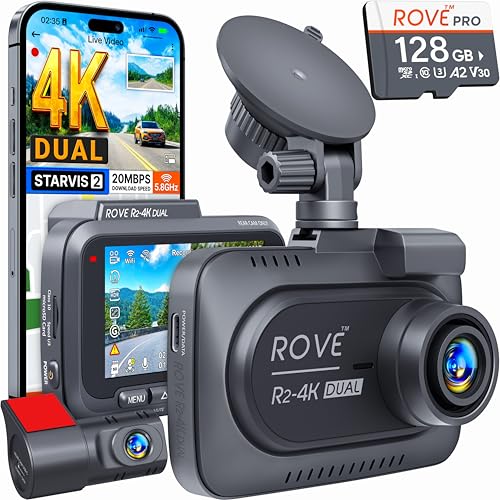
ROVE R2-4K DUAL Dash Cam Front and Rear
A research-led review of the ROVE R2-4K DUAL: 4K front, 1080p rear, built-in GPS, and a heat-tolerant supercapacitor for around $130. Where it earns the value tag, where the corners were cut, and the setup you actually need.
Check PriceWe may earn a commission if you make a purchase through our links.
The ROVE R2-4K DUAL asks a simple question of every more expensive front-and-rear dash cam: what exactly am I paying triple for? At around $130 it puts a 4K front camera, a 1080p rear camera, built-in GPS, and a supercapacitor on your windshield, and for a large share of drivers that is the entire feature list they actually use. This is our research-led take on where it earns the value tag and where the corners were cut to hit the price.
What you get for around $130
The headline is the front camera: 4K UHD at 2160p through a Sony STARVIS sensor, with a wide field of view and the kind of daytime sharpness that lets you zoom into a plate or a street sign after the fact. ROVE builds the R2-4K around a supercapacitor rather than a lithium battery, and that is the spec we most want to highlight, because it is the right engineering call for a device that sits behind glass in direct sun. Supercapacitors tolerate heat far better than lithium cells, which is why cheap battery-based cameras are the ones you hear about swelling or dying after a hot summer.
You also get built-in GPS, which stamps speed and location onto the footage, and Wi-Fi for pairing the phone app to offload clips without pulling the card. The DUAL configuration adds a 1080p rear camera on a long cable for the back windshield. It is a lot of hardware for the money, and the supercapacitor plus GPS combination is genuinely uncommon at this price.
Check the ROVE R2-4K DUAL price
Image quality: sharp front, honest rear
In daylight the front camera is the star. 4K resolution plus a STARVIS sensor produces clean, detailed footage where plates are legible across several car lengths, which is the whole point. At night it is good rather than exceptional. This is first-generation STARVIS, not the STARVIS 2 you get in a Viofo A229 Pro, so under mixed street lighting you will occasionally watch a bright plate bloom out at the exact moment you wanted to read it. In practical terms, that means you can trust the front camera to document a daytime collision in full detail and to give you a fighting chance at a plate under good street lighting, while accepting that a poorly lit side street is the scenario where any camera at this price struggles.
The rear camera is where the budget shows, and honestly so. At 1080p it reliably captures that you were hit and the general shape and color of the vehicle involved. It will not consistently hold a readable plate from a following car at night. That is not a defect; it is the compromise that lets the whole kit cost $130 instead of $280. If rear-plate legibility at night is your priority, you are shopping in a different price bracket, and our best dash cams of 2026 roundup points you there.
Design, mounting, and daily use
The R2-4K mounts with an adhesive bracket rather than a suction cup, which is the more reliable choice for a device you want to stay put through summer heat, though it means committing to a spot on your windshield from the start. The small color screen makes it easy to line up the shot and change settings without pulling out your phone, and the physical buttons are simple enough to learn in a day.
Day to day, most owners rarely touch the camera at all, which is the point. The Wi-Fi app is where you go when something happens: pair the phone, scrub to the clip you need, and save it to your device or share it, without ever removing the card. The GPS overlay stamps speed and location onto that clip, which is exactly the corroborating detail you want if the footage ever ends up attached to a claim or a report. It is not the fastest app in the category, but it does the one job that matters reliably. Loop length is the setting to check first, because a short loop plus a small card is the classic reason footage gets overwritten before you retrieve it.
Parking mode and the setup you actually need
Out of the box the R2-4K runs on the supercapacitor only long enough to shut down cleanly, so it does not record while parked unless you give it constant power. That means a hardwire kit tapped into your fuse box, which also unlocks the low-voltage cutoff that protects your car battery from being drained. It is a straightforward job on most cars, and we walk through it in how to hardwire a dash cam for parking mode.
Grab a hardwire kit for parking mode
The other non-negotiable is the card. A 4K front stream plus a 1080p rear stream writes a lot of data continuously, and a standard phone card will wear out and fail silently. Use a high-endurance card sized to the footage; a 256GB high-endurance card is the comfortable choice for dual-channel 4K, and we cover why in our best microSD cards for dash cams guide.
Who should buy the ROVE R2-4K DUAL
Buy it if you are a commuter who wants credible front-and-rear coverage without spending flagship money, and you value the supercapacitor's heat tolerance and the built-in GPS. It is one of the strongest value picks in our best front and rear dash cam under $150 shortlist for exactly these reasons.
Skip it if night-time rear-plate legibility is your make-or-break requirement, or if you want the absolute best low-light front footage available, in which case a STARVIS 2 camera is worth the upgrade. You can weigh those tradeoffs directly in our comparison hub.
How it stacks up in its class
Within the under-$150 tier the R2-4K DUAL's advantages are the supercapacitor and the built-in GPS, two things budget rivals often drop to hit a lower headline price. Against a three-channel budget unit it trades the cabin angle for better per-stream quality, so the decision hinges on whether you need to record the interior. Against a discreet 4K single like a Rexing, it adds the rear camera at a similar price. We map the whole tier in our best front and rear dash cam under $150 roundup and compare the value 4K options in Nextbase vs Rexing under $200.
Verdict
The ROVE R2-4K DUAL is the camera we recommend when someone wants to stop researching and just get solid coverage on their windshield. The front camera is genuinely good, the supercapacitor and GPS are smart inclusions at the price, and the rear camera is exactly as good as $130 allows and no worse. Add a hardwire kit and a high-endurance card and you have a complete, sensible setup for well under $200.
Check the latest ROVE R2-4K DUAL price
FAQ
Is the ROVE R2-4K DUAL good enough for night driving?
The 4K front camera is good at night for the price, capturing usable footage under street lighting, though very bright plates can occasionally bloom because it uses first-generation STARVIS rather than STARVIS 2. The 1080p rear camera captures the event and the vehicle's shape but will not reliably read a following car's plate in the dark. For most drivers the front performance is the deciding factor, and it holds up well.
Does the ROVE R2-4K DUAL have parking mode?
Yes, but only if you hardwire it. On its supercapacitor alone it powers down cleanly rather than recording while parked, so you need a hardwire kit wired to the fuse box to enable parking mode and the low-voltage cutoff that protects your battery. It is a common upgrade and straightforward on most vehicles.
What size microSD card does the ROVE R2-4K DUAL need?
Use a high-endurance card, and for dual-channel 4K recording a 256GB card is the comfortable size, giving you a long loop before the oldest footage is overwritten. Avoid standard phone cards, which are not rated for the constant write cycle of a dash cam and tend to fail silently over time.
Is the ROVE R2-4K DUAL better than a Viofo?
It is better value; the Viofo A229 Pro is the better camera. The Viofo's STARVIS 2 sensor delivers cleaner night footage and better plate legibility, but it costs roughly twice as much. If your budget is around $130 and you want front-and-rear coverage, the ROVE is the smarter buy; if night image quality is paramount, the Viofo justifies its premium.
No spam. Unsubscribe anytime.
Affiliate Disclosure