Best microSD Cards for Dash Cams 2026 (High-Endurance Guide)
Your dash cam is only as reliable as the card inside it. This guide explains endurance ratings, the capacity you actually need for 4K and multi-channel setups, and the cards that survive years of loop recording.
FTC Disclosure: This article contains affiliate links. If you click and make a purchase, we may earn a commission at no extra cost to you.
The most common dash cam failure has nothing to do with the camera. It is the memory card — a consumer-grade microSD quietly worn out by loop recording, discovered only when you reach for footage that was never saved. Dash cams overwrite their storage continuously, which is a workload ordinary cards were never designed for. This guide covers what actually matters in a dash cam card, how much capacity your setup needs, and the cards worth buying in 2026.
Why "high endurance" is the whole game
A microSD card's flash memory tolerates a finite number of write cycles. A phone or camera card gets written occasionally; a dash cam writes to its card every second the vehicle runs, looping back over old footage when full. A daily commuter can push terabytes through a card in a year.
No spam. Unsubscribe anytime.
High-endurance cards exist specifically for this. They use flash configurations and controllers rated for continuous video recording, and manufacturers spec them in hours of recording — commonly tens of thousands of hours on current cards — rather than just capacity and speed. The practical difference shows up as reliability at month 14, not performance on day one: worn consumer cards corrupt files, drop recording segments, or silently stop saving without the camera complaining.
The rule is simple: buy a card explicitly labeled high endurance for any camera that loop-records. Speed class matters far less — nearly every current card meets the U3/V30 sustained-write floor that even 4K dual-channel dash cams require.
The specs that matter (and the ones that don't)
Matters:
- Endurance rating — the hours-of-recording figure. This is the headline spec for dash cam duty.
- Sustained write class — U3 or V30 covers 4K and multi-channel setups comfortably.
- Capacity — determines how far back your footage history reaches before the loop overwrites it (next section).
- Operating temperature — cars parked in summer sun cook their electronics; high-endurance cards are typically rated for wider temperature ranges than consumer cards, which is part of what you are paying for.
Matters less than marketing suggests:
- Peak read speeds — the big number on the package is for offloading files to a computer, not recording.
- A1/A2 app ratings — those are random-access specs for running phone apps, irrelevant to sequential video writes.
How much capacity you actually need
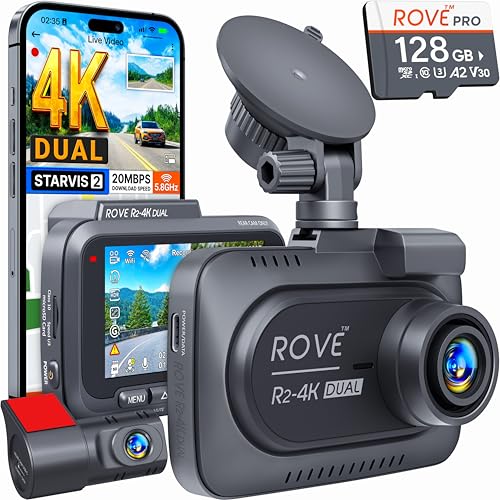
Capacity buys history. A dash cam overwrites the oldest clip when the card fills, so the question is how many hours of driving you want retrievable. Rough planning figures: a single-channel 1080p camera consumes storage slowly enough that 64–128GB holds days of commuting; a 4K front camera roughly doubles that appetite; a 4K + 1080p dual-channel setup — the configuration on cameras like the ROVE R2-4K DUAL — fills 256GB with very roughly 10 to 15 hours of combined footage depending on bitrate settings.
Our guidance by setup:
- 1080p single-channel: 128GB is comfortable.
- 4K single or 1080p dual: 128–256GB.
- 4K dual or three-channel: 256GB minimum; 512GB if your camera supports it and you use parking mode, which quietly consumes storage all night.
Parking mode deserves emphasis: motion-triggered and time-lapse parking recording can add hours of writes per day the car never moves. If you run parking surveillance — see our hardwiring and parking mode guide — size up one tier.
Check your camera's maximum supported capacity before buying; most current cameras take 256GB, many accept 512GB, but some budget and older models cap lower.
Our picks for 2026
Best overall for most dash cams: a 256GB high-endurance card. The 256GB tier is the sweet spot in 2026 — enough history for dual-channel 4K plus parking mode, at prices that have fallen to commodity levels. The GIGASTONE 256GB dash cam card is a strong value at around $65: it is endurance-rated for dash cam duty, U3/V30 class, and bundles a five-year free data recovery service — a genuinely useful inclusion in the one product category where the data on the card is the entire point.
Best approach if you want a name-brand alternative: the major-brand high-endurance lines (Samsung PRO Endurance and SanDisk's High Endurance and MAX Endurance families are the recurring community picks) all do the job; choose by price-per-gigabyte on the day you buy. Browse current high-endurance dash cam cards and filter for the "endurance" label and V30 rating — the field is deep and discounts rotate constantly.
For three-channel and heavy parking-mode users: same brands, 512GB tier, camera permitting. The cost per gigabyte is usually slightly worse than 256GB, but doubling your retrievable history is worth it when an incident surfaces days after it happened — the exact scenario in our street parking protection guide.
Quick-pick table
| Setup | Capacity | What to buy |
|---|---|---|
| 1080p single-channel | 128GB | Any name-brand high-endurance card |
| 4K single / 1080p dual | 128–256GB | 256GB if you use parking mode |
| 4K dual (e.g., ROVE R2-4K DUAL) | 256GB | GIGASTONE 256GB bundle or brand equivalent |
| 3-channel / heavy parking mode | 512GB | Name-brand endurance line, camera permitting |
Buy the real card: counterfeit warnings
MicroSD is one of the most counterfeited product categories online, and a fake "256GB" card that actually holds 32GB will loop-record its way into data loss without a single error message. Protect yourself with three habits: buy from listings sold and shipped by the retailer or the brand's official storefront rather than unknown third-party sellers; be suspicious of prices dramatically below the going rate for the tier; and test a new card on arrival — record for a few minutes, play the clips back, and confirm the camera reports the full capacity. A free tool like an SD capacity tester can verify the flash is genuine, but for most buyers the record-and-review check catches the worst fakes in five minutes.
Card care: the 90-second maintenance habit
- Format in the camera, not your computer, and do it every month or two. In-camera formatting keeps the file system aligned with how the camera writes and clears fragmentation-related errors before they corrupt footage. Most cameras will nag you on a schedule; obey the nag.
- Lock important clips immediately. Loop recording will eventually eat any unsaved event; use the camera's event-lock button or pull the clip via the app the same day.
- Replace on schedule, not on failure. Heavy daily drivers should treat cards as an 18–24 month consumable; light drivers get longer. A $50 replacement is cheap insurance against discovering a dead card after a collision.
- Watch for the warning signs: recording gaps in the timeline, "card error" prompts, or clips that end early all mean the card is dying — replace it that week, not eventually.
When a card fails with footage you actually need still on it, stop using it immediately — every additional loop pass overwrites more of what might be recoverable. Recovery software such as EaseUS's SD card recovery tool can scan a corrupted or accidentally formatted card and pull off video files the camera hasn't yet overwritten. It's not guaranteed — reused sectors are gone for good — but it's worth running on a just-failed card before you retire it.
The bottom line
Buy endurance-rated, buy 256GB unless your setup argues otherwise, format it in-camera monthly, and replace it before it fails. Storage is the cheapest component in your dash cam system and the one most likely to determine whether the footage exists when you need it. If you are still choosing the camera itself, start with our current dash cam rankings — and whatever you pick, budget the extra $50–65 for a proper card rather than starving a $200 camera with a $12 one.
FAQ
Can I use a regular microSD card in a dash cam? It will work — briefly. Consumer cards are not rated for continuous loop recording and typically degrade into corrupted files or silent recording failures well before a high-endurance card would. Given the price gap has narrowed to a few dollars, running a non-endurance card in a dash cam is a false economy.
How many hours of footage does a 256GB card hold? Depends on resolution, channels, and bitrate. As rough figures: roughly 10–15 hours for a 4K + 1080p dual-channel setup, more for single-channel or lower resolutions. The camera loops over the oldest footage automatically, so capacity determines how far back you can reach, not whether recording continues.
How often should I format my dash cam's memory card? Monthly, using the camera's own format function. In-camera formatting prevents the file-system fragmentation that causes dropped segments and corrupt clips. Save any footage you want to keep first — formatting erases everything, including locked event files on most cameras.
Do dash cam cards really wear out? Yes. Flash memory has finite write cycles, and loop recording is close to a worst-case workload. High-endurance cards are engineered and warrantied for it, but even they are consumables on a multi-year horizon. Treat gaps in your recording timeline or card-error messages as an immediate replacement signal.
Affiliate Disclosure