Do You Need a Supercapacitor Dash Cam in a Hot Climate? Yes, and Here Is Why
A parked car's dashboard can reach 180°F to over 200°F per the National Weather Service, while lithium-ion cells stop charging safely at 45°C. Here is why a supercapacitor dash cam is the right buy in a hot climate, with the published heat ratings for Viofo, Rexing, Rove and Vantrue models.
Do I need a supercapacitor dash cam if I live in a hot climate?
Yes. If your car sits outside in a hot climate, buy a dash cam with a supercapacitor instead of a lithium battery: the National Weather Service says a dark dashboard can reach 180°F to over 200°F, and Battery University puts a lithium-ion cell's charging limit at 45°C (113°F). Supercapacitor cameras publish heat ratings a battery cannot match: Viofo's A229 Pro lists -20°C to 65°C at $349.99, Rexing's R88 claims -5°F to 149°F at $359.99, and Rove's R2-4K DUAL claims -4°F to 158°F at $199.99 (checked October 2026).
This page is built from the National Weather Service's heat-safety guidance, Battery University's published temperature limits for rechargeable cells, the makers' own spec pages for each camera named, and WOLFBOX's published explainer on supercapacitors, rather than first-hand use.
How hot the inside of a parked car actually gets
No spam. Unsubscribe anytime.
A dash cam lives in the hottest spot in the car: pressed against the windshield, in direct sun, often above a dark dashboard. The National Weather Service's heat guidance states that "Even on mild days in the 70s, studies have shown that the temperature inside a parked vehicle can rapidly rise to a dangerous level for children, pets and even adults", that "Leaving the windows slightly open does not significantly decrease the heating rate", and that "A dark dashboard or car seat can quickly reach temperatures in the range of 180°F to over 200°F." Those surfaces then heat the trapped air by conduction, convection and long-wave radiation.
WOLFBOX's explainer, written from the dash cam side, puts the cabin-air figure at a similar level: "The inside of a car parked in direct sunlight can get as hot as 160 degrees Fahrenheit." Whichever number you take, a camera on the glass in Phoenix, Las Vegas, Houston or Orlando spends every summer afternoon far outside the comfort zone of a consumer battery.
Why lithium batteries and dashboards do not mix
Battery University's table of permissible temperatures gives lithium-ion a charge range of "0°C to 45°C (32°F to 113°F)" and a discharge range of "–20°C to 60°C (–4°F to 140°F)", with the note "Good charge/discharge performance at higher temperature but shorter life." The same page explains that "Batteries can be discharged over a large temperature range, but the charge temperature is limited." A dash cam battery is being charged the entire time the car runs, so a battery camera in a hot car is charging at or beyond its ceiling every afternoon, which is the condition that shortens its life. WOLFBOX describes the failure mode bluntly: "When lithium batteries are in the sun for a long time, they swell and leak."
A supercapacitor stores energy in an electric field rather than in a chemical reaction, so it has no electrolyte to swell. WOLFBOX's comparison table lists a lifespan of "100,000+ cycles" for a supercapacitor against "300-500 cycles" for a lithium battery, and a working range of -4°F to 158°F against 32°F to 113°F. Treat the maker's table as the maker's claim, but it agrees with Battery University's independent limits for lithium-ion, and with every supercapacitor camera spec sheet we could find.
What a supercapacitor does, and what it cannot do
The trade-off is capacity. WOLFBOX explains that the supercapacitor "gives you just enough power to save your current file before the camera shuts off" when the car loses power, and answers the obvious follow-up directly: "Can a supercapacitor power a dash cam when the car is off? No, it only holds power for a few seconds. You need a hardwire kit connected to your car battery for overnight video." That is why every supercapacitor camera that offers parking mode also sells a hardwire kit; Rove's own FAQ states "ROVE Ultimate Hardwire Kit is required for Parking Mode to work", and Viofo's product pages carry the same note.
So the honest answer to the headline question has two halves. For driving-mode recording in a hot climate, a supercapacitor camera is the right choice and there is no downside. For parking-mode recording, a supercapacitor camera still needs a hardwire kit or an external battery pack, and that pack, if you choose one, is itself a lithium cell that you will want to mount low and out of the sun. Our battery pack versus hardwire kit comparison weighs those two options.
Published heat ratings, camera by camera
| Camera (price checked October 2026) | Power source per the maker | Published temperature claim | Price at the maker |
|---|---|---|---|
| Viofo A229 Pro 2CH | "NO Battery, built-in Super Capacitor" | operating -20°C to 65°C, storage -20°C to 70°C | $349.99 |
| Viofo A119 Mini 2 | "NO Battery, built-in Super Capacitor" | operating -20°C to 65°C, storage -20°C to 70°C | $159.99 |
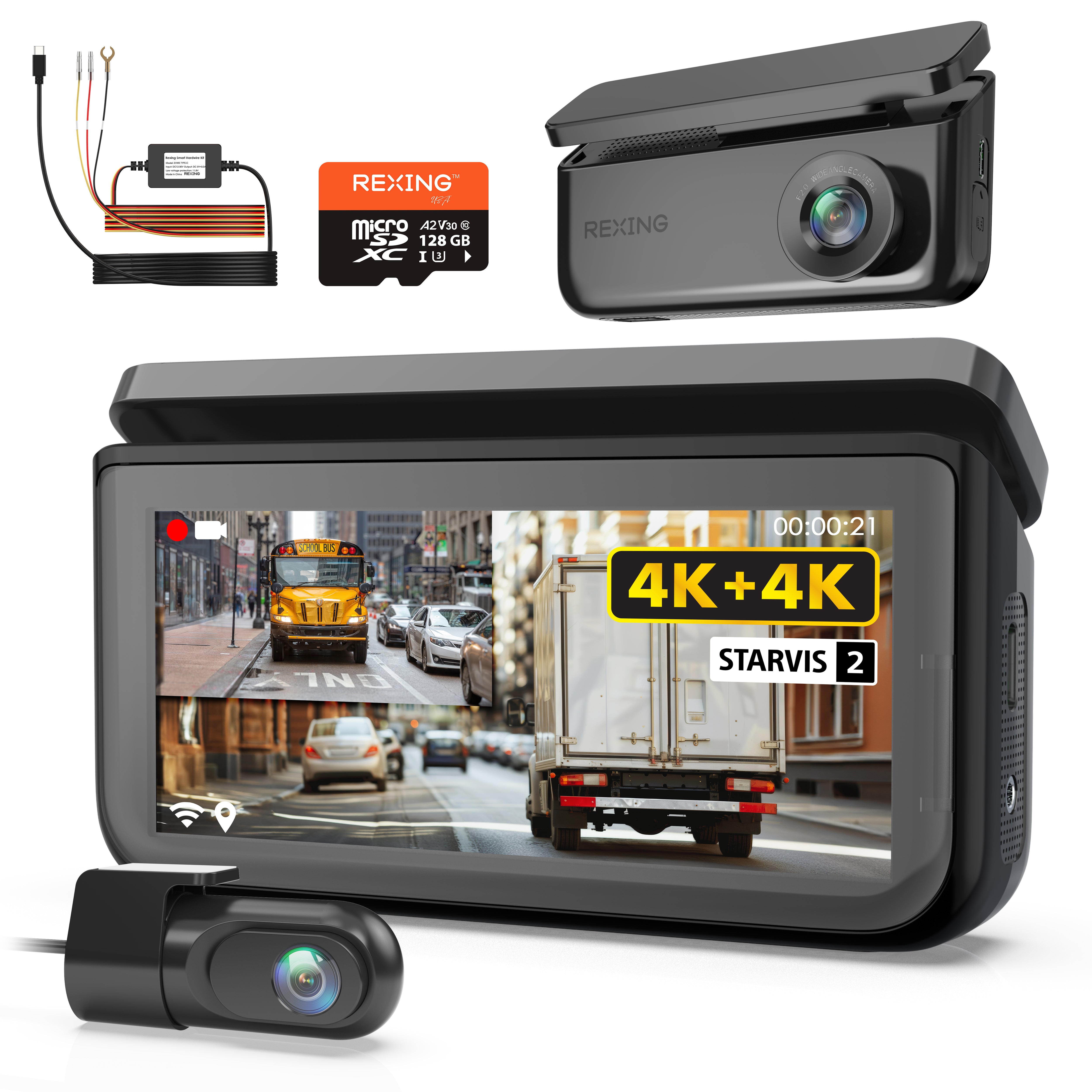
| Rexing R88 | "Powered without a lithium-ion battery" | -5°F to 149°F | $359.99 |
| Rove R2-4K DUAL | supercapacitor | -4°F to 158°F | $199.99 |
| Vantrue N4 Pro | supercapacitors instead of batteries | "withstands the most frigid cold and intense heat", no figure published | $349.99 USD |
Two cautions when you read that table. First, the makers quote different things: Viofo publishes an operating range in Celsius on its spec sheet, while Rexing and Rove publish Fahrenheit claims in marketing copy, and Vantrue publishes no number at all. Second, an operating range describes the air around the camera while it runs, not the surface temperature of a dashboard left in the sun, so a 65°C rating is not a promise that the camera survives a 200°F dashboard. Parking in shade and using a windshield sunshade still matter.
The picks for a hot climate
Viofo A229 Pro 2CH and A119 Mini 2
Viofo's spec sheets are the most explicit in the group: every model lists "NO Battery, built-in Super Capacitor" with an operating range of -20°C to 65°C and a storage range of -20°C to 70°C. The A229 Pro 2CH at $349.99 is the front-and-rear choice, with a 4K Sony STARVIS 2 IMX678 front sensor and a 2K rear camera, and Viofo includes the CPL-200 polarizer in the box, which matters in bright sun. The A119 Mini 2 at $159.99 is the small front-only choice with the same power design and the same operating range. Both need Viofo's HK4 hardwire kit for parking mode. Our Viofo A229 Pro review covers the camera in full. Check the A229 Pro price at VIOFO Ltd or check the A119 Mini 2 price at VIOFO Ltd.
Rexing R88
The R88 is Rexing's dual-4K camera, and its product page makes the heat claim in plain words: "Powered without a lithium-ion battery, this dash cam withstands extreme temperatures from -5°F to 149°F, perfect for all climates." It lists at a sale price of $359.99 against a regular price of $399.99 on rexing.com, and the smart hardwire kit comes in the box, which saves a separate purchase for parking mode. Check the R88 price at rexing.com.
Rove R2-4K DUAL
Rove's FAQ answers the hot-climate question by name: "Unlike dash cams with regular batteries, our supercapacitor technology works reliably in temperatures from -4°F to 158°F." The R2-4K DUAL lists at $199.99 on Rove's store with a 128GB card included, and Rove backs it with "a 30-day money-back guarantee and a 1-year warranty." It is the budget front-and-rear choice here; our ROVE R2-4K DUAL review covers its image quality. See current ROVE listings on eBay.
Vantrue N4 Pro
For a three-channel camera with a cabin view, Vantrue's N4 Pro lists at $349.99 USD and its page states that the power system "is based on supercapacitors instead of batteries, which guarantees more safety, withstands the most frigid cold and intense heat and has longer lifespan than batteries." Vantrue does not publish a temperature range, so weigh that claim accordingly. Our Vantrue N4 Pro review covers the rest of the camera. See current Vantrue listings on eBay.
Heat habits that matter as much as the spec sheet
- Mount high and tuck it behind the mirror. The camera sits in the shaded band at the top of the glass instead of in full sun over the dashboard.
- Use a sunshade when parked. The National Weather Service notes that cracking the windows does little; a reflective shade cuts the dashboard surface temperature that the camera radiates against.
- Buy a high-endurance card and check it. Heat and constant loop writing are hard on flash memory, and a corrupted card is the most common way a hot-climate camera fails silently. Our microSD guide explains the endurance ratings; format the card in the camera monthly and play back a clip to confirm it recorded.
- Keep the lens clean and fit a CPL. Glare is worse in sunny regions, and a polarizer is the only fix that works on footage rather than after it.
- Mount any battery pack low and shaded. If you choose a parking-mode battery over a hardwire kit, it is a lithium cell, and the same temperature limits apply to it.
FAQ
Will a battery-powered dash cam catch fire in a hot car?
Battery University's published limits say lithium-ion should not be charged above 45°C (113°F) and that higher temperatures shorten its life, and WOLFBOX states that batteries left in the sun "swell and leak." Swelling and early failure are the common outcomes; fire is rare and we have no data to put a number on it. The practical point is that a swollen battery is a camera that stops recording, usually without warning.
Do supercapacitor dash cams work in the cold too?
Yes. The same spec sheets cover winter: Viofo lists operation down to -20°C, Rexing claims -5°F, and Rove claims -4°F. Battery University notes that lithium-ion has "No charge permitted below freezing", so a supercapacitor camera is the better choice at both ends of the thermometer.
Can a supercapacitor dash cam record while the car is parked?
Only with a power source. WOLFBOX's explainer says the supercapacitor "only holds power for a few seconds", and Rove's FAQ says its hardwire kit "is required for Parking Mode to work." Hardwire kits connect to the fuse box with a low-voltage cutoff; our hardwiring and parking-mode guide covers the install, and our street-parking protection guide covers which cameras do it best.
Is a 65°C rating enough for Arizona or Texas?
It is the cabin-air rating while the camera runs, and it is the figure Viofo publishes for its supercapacitor models. It is not a promise about dashboard surface temperatures, which the National Weather Service puts at 180°F to over 200°F in the sun. Mount the camera at the top of the glass, use a sunshade, and pick a camera that publishes its range rather than one that only promises to withstand "intense heat."
Are there still battery dash cams on sale?
Yes, mostly in compact and budget designs, and some makers do not say which power source they use. If a product page does not mention a supercapacitor, assume a battery and ask before buying. Every camera recommended on this page names its power source on its own product page, which is the first thing to check if you shop beyond this list; our dash cam cost breakdown shows where the supercapacitor models sit on price.
Sources
- During a Heat Wave — National Weather Service (NOAA) (checked October 2026)
- BU-410: Charging at High and Low Temperatures — Battery University (checked October 2026)
- VIOFO A229 Pro 2CH 4K+2K Dual Dash Cam — VIOFO (checked October 2026)
- VIOFO A119 Mini 2 2K 60FPS Front Dash Cam — VIOFO (checked October 2026)
- Vantrue N4 Pro 4K Dash Cam – 3-Channel, Night Vision, WiFi & GPS — Vantrue (checked October 2026)
- Rexing R88 4K Front + 4K Rear Dual Sony STARVIS Dash Cam — Rexing (checked October 2026)
- ROVE R2-4K DUAL Dash Cam Front and Rear — ROVE (checked October 2026)
- Supercapacitor Dash Cam: The Ultimate Solution for Extreme Conditions — WOLFBOX (checked October 2026)
Affiliate Disclosure