Best Dash Cams of 2026: Top Picks for Every Budget
The best dash cams of 2026, chosen by sensor, thermal design, and parking-mode capability rather than the megapixel number on the box. Picks for every budget, from 4K STARVIS 2 flagships to value front-and-rear kits under $150.
A dash cam in 2026 is no longer a novelty gadget. It is closer to a cheap insurance policy that happens to record in 4K. Three things reshaped the market over the last two years: Sony's STARVIS 2 sensors trickled down from $400 flagships into the $150 to $280 range, front-and-rear became the default instead of a paid upsell, and parking mode stopped being a checkbox and became the reason most people buy at all.
That changes the buying question. It is no longer "which camera has the most megapixels." It is "which camera holds a readable license plate at night, and which one will not cook itself or flatten your battery in a hot parking lot." Below are our picks for every budget, chosen the honest way: from published sensor and hardware specs, owner-reported reliability, and the tradeoffs each design forces. No lab, no staged 40-hour test claims, just the reasoning we would use buying one ourselves.
How we chose these dash cams
We weighted four things in this order. First, low-light plate legibility, because a daytime 4K clip is easy and the footage you actually need is at night. Sensor generation matters more here than the resolution number on the box. Second, thermal survival and power design, since a windshield in July is the harshest place most electronics ever live. Third, parking-mode capability, because a parked car is where most incidents you did not witness happen. Fourth, the total cost of a working setup once you add a high-endurance card and, usually, a hardwire kit. A $110 camera with a $25 card and a $26 hardwire kit is a $161 decision, and we priced accordingly. For the full breakdown of what a real setup runs, see how much a dash cam actually costs in 2026.
No spam. Unsubscribe anytime.
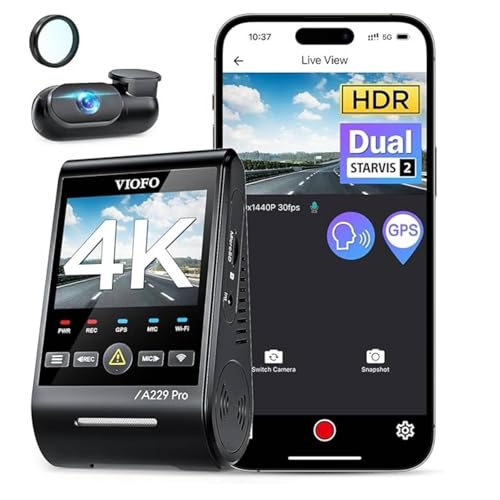
Best overall: Viofo A229 Pro
If image quality is the only thing you care about, this is the shortlist and the whole list. The A229 Pro pairs a Sony STARVIS 2 sensor with proper HDR, and in the front-and-rear or three-channel configurations it is the camera enthusiasts point newcomers toward. STARVIS 2 is the generational jump that matters for the footage you buy a dash cam to capture: headlights bloom less, and a plate under a streetlight stays legible instead of smearing into a white bar.
It is not the cheapest pick at around $280, and the app and firmware ask a little more patience than a Garmin. But you get 5GHz Wi-Fi for fast clip transfers, Bluetooth, voice control, and a genuinely good buffered parking mode. If you want the reasoning in full, we wrote a dedicated Viofo A229 Pro review, and we put its night performance head to head in Garmin vs Viofo on license-plate legibility. Viofo also sells direct: VIOFO's own store carries its cameras and accessories if you would rather buy from the brand than from a marketplace listing.
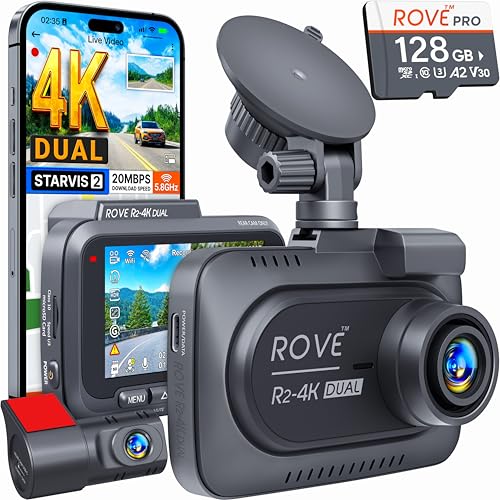
Best value front and rear: ROVE R2-4K DUAL
For most drivers this is the sweet-spot recommendation. Around $130 buys a 4K front camera, a 1080p rear camera, built-in GPS, and a supercapacitor instead of a lithium battery, which is exactly the right call for a device that bakes on glass all summer. ROVE lists a Sony STARVIS sensor up front, and while it is the first-generation STARVIS rather than the newer STARVIS 2 in the Viofo, the daytime footage is genuinely sharp and the night footage is acceptable for the money.
The compromise is the rear camera. At 1080p it is fine for capturing that you were rear-ended and roughly what hit you, but do not expect to read a plate from three car lengths back at night. For a commuter who wants coverage front and back without overthinking it, the value is hard to argue with. We break down the full case in our ROVE R2-4K DUAL review, and it anchors our roundup of the best front and rear dash cams under $150.
Best for rideshare and three-channel coverage: Vantrue
Uber and Lyft drivers, and anyone who wants the cabin on record, should start with Vantrue. The brand's specialty is multi-channel: front, cabin, and rear in one unit, with infrared LEDs so the interior camera can see faces in a dark car without blinding your passengers. The N4 Pro's front camera steps up to a STARVIS 2 sensor, which closes most of the night-time gap to the Viofo while adding the interior angle a rideshare driver actually needs for disputes.
The tradeoff is that three streams eat storage and generate heat, so a high-endurance card is mandatory rather than optional here. Around $190 for the multi-channel Vantrue is reasonable given what it replaces. We go deeper in our Vantrue N4 Pro three-channel review for rideshare.
See the Vantrue multi-channel price
Best compact and best ecosystem: Garmin Dash Cam 67W
Not everyone wants a gadget with a big screen glued to the windshield. The Garmin Dash Cam 67W is the size of a key fob, records 1440p across a wide 180-degree field of view, and runs the most polished software in the category with reliable voice control and a genuinely useful phone app. It is the camera we recommend to people who value "it just works" over spec-sheet bragging rights.
The honest caveat is resolution: 1440p is a step below the 4K front cameras above, so on a very wide scene a distant plate has fewer pixels to work with. Garmin counters with excellent processing and dynamic range, and its discretion is a real feature in a smash-and-grab city. Around $200 buys the small footprint and the ecosystem. See our Garmin Dash Cam review for the details.
Check the Garmin Dash Cam 67W price
Best budget 4K: Rexing and Nextbase
Under $170 the two names worth your time are Rexing and Nextbase, and they solve different problems. Rexing leans into discreet 4K value: a small body, solid daytime capture, and a price around $145 that leaves room in the budget for a good card. Nextbase leans into its ecosystem, with modular mounting, Emergency SOS on higher models, and a polished interface at around $170. Neither will out-shoot the STARVIS 2 cameras at night, but both are honest 4K options for a tight budget. We put the value pair side by side in Nextbase vs Rexing 4K under $200.
The choice between them usually comes down to what you value. Nextbase's Click and Go magnetic mount makes it the easiest camera here to pull off the glass and take inside, and its Emergency SOS feature can alert responders if you are in a crash and unresponsive, which is a genuine safety argument rather than a gimmick. Rexing's pitch is simpler: more resolution and a lower profile for less money, with fewer ecosystem features to pay for. For a buyer who wants the camera to disappear into the windshield and just record, Rexing is the pick; for one who wants safety features and easy handling, Nextbase earns its small premium.
One buying note if Rexing wins your coin flip: the brand also sells direct, and the Rexing official store carries its current 4K lineup alongside the rear camera modules, hardwire kits, and replacement mounts most buyers end up adding anyway. It is worth a look before checkout, since ordering direct makes it easier to pair the camera with the exact accessories for that model.
Best rearview mirror cam: WOLFBOX G930
If you would rather not clutter your windshield with a second device, a mirror-style cam replaces your existing rearview mirror with a camera and a full-width streaming display. The WOLFBOX G930 is our starting recommendation in this style at around $150: the rear feed streams to the mirror so a headrest or a tall passenger never blocks your view, and the front camera records the road. Mirror cams are polarizing and not for everyone, so we wrote a full buyer's guide in our WOLFBOX G930 mirror dash cam review.
Match the camera to how you drive
The best dash cam is the one that fits your specific risk, not the one that wins a spec sheet, and a few common profiles make the choice obvious.
If you are a daily highway commuter, prioritize a sharp front camera and add a rear for tailgating and rear-end disputes; the ROVE R2-4K DUAL covers this for the least money. If you drive for Uber or Lyft, the cabin angle is not optional, and a three-channel Vantrue is built for exactly that job. If you park on a city street overnight, parking mode and a clean power setup matter more than headline resolution, so read our street parking protection guide and budget for a hardwire kit. If you road-trip and want set-and-forget reliability, the Garmin's small footprint and mature software are worth the resolution tradeoff. And if a cluttered windshield is the thing stopping you from buying at all, a mirror cam removes the objection entirely.
Start from the scenario, then pick the sensor and the setup that serves it. That order keeps you from overpaying for pixels you will never use, or underpaying for a camera that misses the shot you actually needed.
The specs that actually matter, and the ones that do not
Sensor beats resolution
The single most common mistake is buying the biggest resolution number. A 4K camera with an older sensor can lose to a 1440p camera with a STARVIS 2 sensor the moment the sun goes down, because resolution counts pixels while the sensor decides how much light each pixel gathers. When you compare two cameras, find the sensor before you find the megapixels. The practical shortcut: a current STARVIS 2 camera is a safe night performer, a first-generation STARVIS camera is good, and anything that will not name its sensor at all is usually hiding an older, weaker one.
Parking mode is the real feature
Most of the footage people are desperate for later is of a hit-and-run or a break-in that happened while they were nowhere near the car. Parking mode is what captures it, and it only works if the camera is wired to constant power through the fuse box, usually with a small hardwire kit that cuts off before it drains your battery. If you plan to use it, read how to hardwire a dash cam for parking mode first, and if you park on the street specifically, our guide to street parking protection covers the settings that matter.
Your microSD card is part of the camera
A dash cam records in a constant loop, overwriting the oldest footage forever. A normal phone card is not built for that write cycle and will fail, often silently, so the day you need the footage the card is corrupt. Buy a high-endurance card rated for continuous recording, sized to your resolution and channel count. We cover sizing and the specific cards worth buying in our best microSD cards for dash cams guide.
Quick picks
| Pick | Camera | About | Why it wins |
|---|---|---|---|
| Best overall | Viofo A229 Pro | ~$280 | STARVIS 2 night footage, best plate legibility |
| Best value | ROVE R2-4K DUAL | ~$130 | 4K front, supercapacitor, front-and-rear cheap |
| Best for rideshare | Vantrue multi-channel | ~$190 | Front, cabin, and rear with IR interior |
| Best compact | Garmin Dash Cam 67W | ~$200 | Tiny, discreet, best software |
| Best budget 4K | Rexing / Nextbase | ~$145 to $170 | Honest 4K without the flagship price |
| Best mirror | WOLFBOX G930 | ~$150 | Streaming rear view, no windshield clutter |
Whichever way you lean, buy the sensor and the setup, not the marketing number. If you want to line these up spec by spec, use our dash cam comparison hub, or browse the shop while you are here.
FAQ
What is the best dash cam in 2026 overall?
For pure image quality, the Viofo A229 Pro is our top pick because its Sony STARVIS 2 sensor holds a readable license plate at night better than anything near its price. If you want the best value instead of the best image, the ROVE R2-4K DUAL delivers 4K front-and-rear coverage for around $130. The right answer depends on whether you are optimizing for footage quality or for total cost.
Is a 4K dash cam worth it over 1440p or 1080p?
4K helps in daylight, where extra resolution lets you zoom into a plate or a face. At night the sensor matters more than the resolution, which is why a 1440p camera with a STARVIS 2 sensor can beat an older 4K camera in the dark. Buy 4K if the sensor is also modern; do not buy 4K on an old sensor and expect night miracles.
Do I need a front and rear dash cam, or just a front camera?
A rear camera earns its place if you commute in traffic, since rear-end collisions and tailgating disputes are common and a front-only camera cannot see them. If you mostly drive open roads or park in a private garage, a strong front camera may be enough. For most city and highway commuters, front-and-rear is the better default.
What else do I need to buy besides the camera?
Almost always two things: a high-endurance microSD card sized for your resolution, and, if you want parking mode, a hardwire kit to wire the camera to constant power. Budget for both up front, because a camera with a failing consumer card or no parking power is only doing half the job you bought it for.
Affiliate Disclosure